Join our grey squirrel damage survey
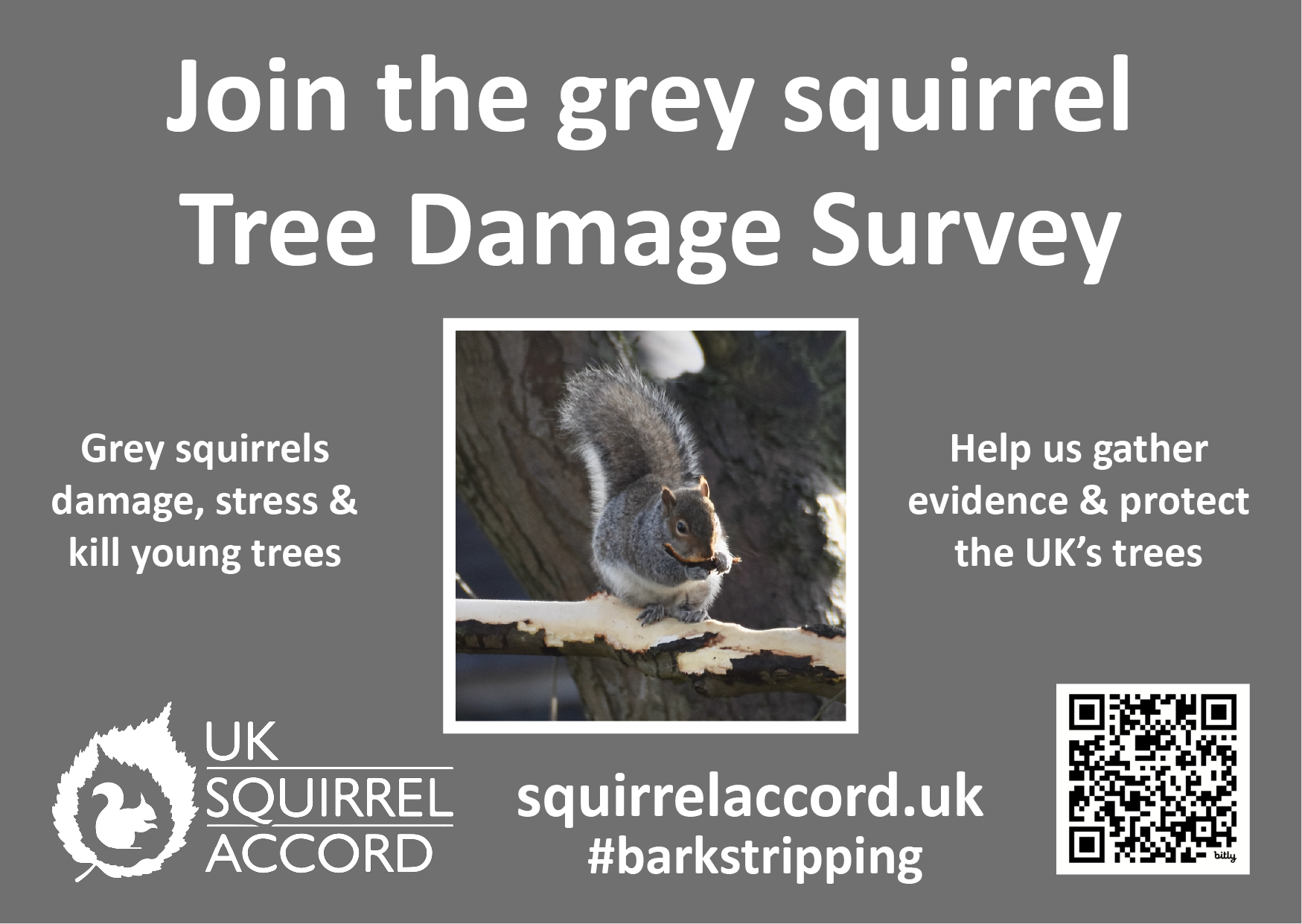
We are calling on everyone that cares for the UK’s woodlands to collect and submit data on the negative impacts of grey squirrel bark stripping. Join our annual survey to gather evidence of damage and increase tree protection.
Grey squirrels, Sciurus carolinensis, are one of the UK’s worst invasive species. While awareness of red and grey squirrel conflicts is well known, there is far less understanding of the issue of greys damaging and killing trees like oaks, Quercus spp., through bark stripping – costing England and Wales at least £37 million each year. UKSA asks individuals to survey woods during 2026 for grey squirrel damage and report their findings to contribute to a better evidence base that helps raise awareness and encourages action.
Anyone with landowner permission can carry out the user-friendly Grey Squirrel Activity and Impact Assessment, designed by The National Forest (TNF), in woods across the UK. Then submit the results into our simple online UK Squirrel Accord (UKSA) survey. The aim is to better understand the scale of bark stripping problems across the UK to help guide future action and raise awareness. Please aim to submit this year’s results by the end of January next year.
In England, you may carry out the TNF assessment as part of requirements to access the Forestry Commission’s CWS3 grant that funds grey squirrel management activities. If so, please submit your results to the UKSA survey to help us gather this important data.
Assessment method
TNF’s Grey Squirrel Activity and Impact Assessment involves walking a transect through a woodland and stopping every 100 m to collect data. Late autumn and early winter (after the leaves have fallen) are great times to capture this year’s damage, as it is easier to see bark stripping all the way up the tree.
At each transect stop the surveyor records squirrel activity indicators:
-
Number of dreys seen within a 30 m radius.
-
Number of feeding sites seen within a 30 m radius.
The surveyor also records bark stripping damage of the five closest trees to the stop with a diameter at breast height great than 7 cm. Recording:
-
Tree species
-
Location of damage – basal, mid-stem, crown
-
Severity of fresh damage – 0-5 scale (size examples shown in method)
-
Severity of cumulative damage – 0-5 scale (size examples shown in method)
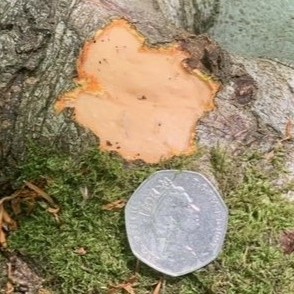
Fresh damage has taken place within the last 12 months and is generally a brighter colour that can show rough edges, teeth marks and discarded bark strips at the tree base. Cumulative damage is both historic and fresh damage. Old damage is usually more faded and is callousing over as the tree tries to heal the wounds.
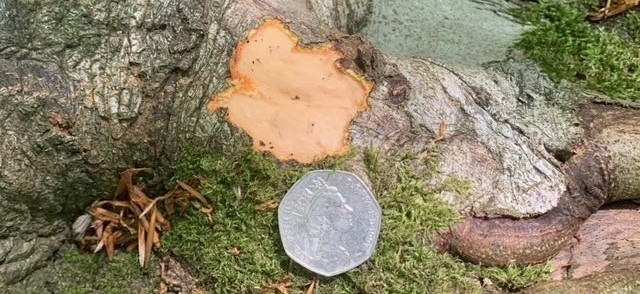
Example of fresh damage score 1 – tester patch created by grey squirrel
Species damage and levels
Oak is one of the UK’s most ecologically and economically important trees, and one of the worst impacted by grey squirrels. Oaks support over 2,300 species, more than any other species of tree in the country. One Royal Forestry Society member reported losing 90% of the oaks trees they planted because of bark stripping. In many areas, we are losing our most biodiverse tree in the landscape through physical lose and a reluctance to plant a tree that will be so badly impacted. This makes it both a forestry and conservation issue that strengthens the need for effective grey squirrel management.
Mast years and mild winters are recognised as factors boosting grey squirrel numbers. The mast year in 2022 was followed by two mild winters and resulted in anecdotal reports of significantly high levels of damage and numbers of grey squirrels in 2024. One individual found them not only bark stripping broadleaved trees but also damaging large areas of Norway spruce.
In 2025 there was an oak mast followed by a mild but wet winter and the autumn of 2026 delivered a beech mast. Will that result in a significant increase in grey damage over the next couple of years? Collating data through the UKSA survey will help provide evidence to understand changes.
Grey squirrel is an established and widespread invasive non-native species. Siting it in the category of the most difficult to manage or eradicate from areas. However, if we want healthy mature woods and our oaks to survive for the future then grey squirrel management is an essential task to protect them. Grey squirrel management is most effective when conducted at a landscape scale in partnership with other landowners.
Forest Research has a useful technical note online: Controlling grey squirrels in forests and woodland in the UK, published in December 2019. This sets out detailed guidance for managing grey squirrels, including strategies and methods.
Value of surveying
Surveying for grey squirrel bark stripping is a valuable way to understand levels of damage to trees and wooded areas. Providing useful information that feeds into management plans to protect young trees and vulnerable woodlands. Making it a useful activity for landowners and managers to monitor damage and change over time.
We plan to create a rolling programme of data gathering over the next few years. Enabling us to build a comprehensive dataset that creates a picture of current damage and enables monitoring of change over time. Contributing to the important need to keep telling the story of negative grey squirrel impacts to our valuable trees and woodland ecosystems.
Please get involved this year by carrying out or allowing an assessment of your woods and feeding the results into the our online survey. Hopefully more data can be gathered that encourages more action to protects our trees and woods. All resources and links are available online – click the button below. Contact UKSA with any questions or requests for survey training.
Related blog articles
We do not use analytics or advertising cookies. Some pages contain privacy-gated third-party content, such as YouTube videos, which is only loaded if you choose to view it.ClosePrivacy policy